portfolio web templates

Flat roofing repair

LEAKING GUTTERS

Before blaming your flat roofing membrane for a leak, you might want to check your gutters. Blocked gutters (via leaves, debris) cause rainwater to overflow into the adjacent flat roofing structure, leading to a leak. Simply unblocking your gutters, allowing the roof to dry out and then inspecting the leaking area the next time it rains can sometimes be enough to fix the problem. 

LEAD FLASHING

Another cause of a leaking flat roof is lead flashing breakdown. Designed to provide waterproofing between the flat roof and the main building, lead flashing can peel away - particularly if it old or has been poorly installed. In such cases, we advise you to check for peeling or detachment. You could make your own repairs by purchasing a high-quality lead flashing system and applying it yourself. Check the leak the next time it rains to rule this out and eliminate your leak.

PUNCTURES - A HOLE IN YOUR FLAT ROOF AND HOW TO REPAIR IT

Punctured flat roofs are fairly easy to repair if the leak is localised to known regions. These are typically caused by excessive pressure (footfall, equipment - e.g. ladder placement).
The following section provides some basic guidelines to repair punctures or leaking patches of your roof. We recommend that for any resin you use, be it polyester resin for glass fibre or polyurethane, you closely follow the manufacturer’s instructions. Typically a foam roller or a brush could be used to apply either resin to the surface.
This type of work should be performed when the surface has been dried and adequate dry time (minimum 24 hours) is allowed for both resins to safely cure.
Repairing single ply flat roof

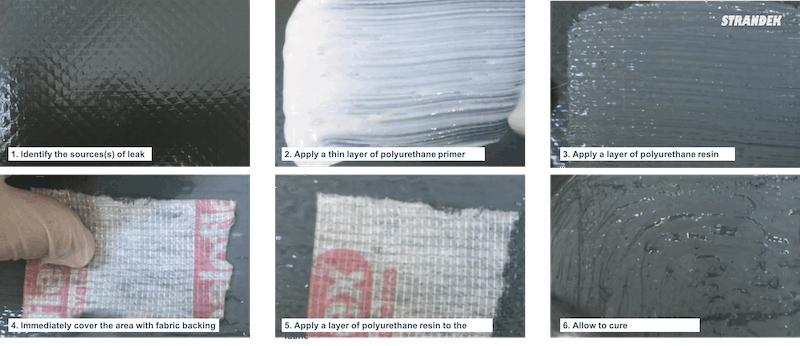
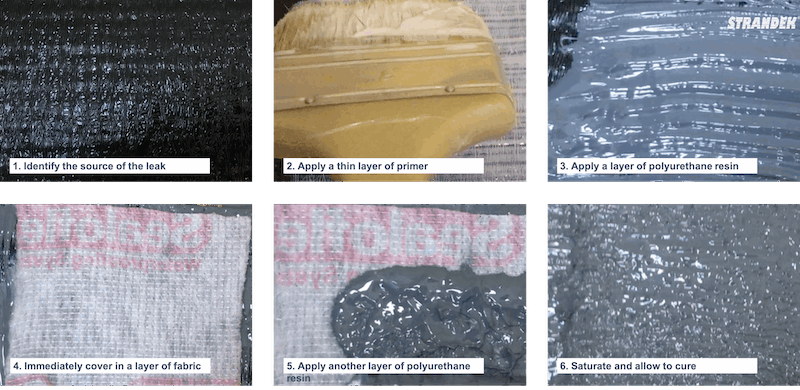
Single ply is easily to repair - the hard part is identifying the leak, often requiring specialist equipment. If you have identified the leak, you can apply a 6-step process to repair the leak using polyurethane resin. This is a paint on system that allows the user to quickly and reliably fix their leaking flat roof.
Before starting this work, we recommend you dry the region out and sand it back using sandpaper. Once complete, these steps can be followed to patch up any leaks. 

Mobirise

Repairing a leaking bitumen flat roof

Bitumen-based flat roofs are robust, but older ones or ones that are made from weaker substrates have a tendency to degrade and puncture prematurely. In such cases, the property or homeowner can implement repairs using polyurethane resin. Like single ply, the surface should be sanded back to remove loose debris and adequately dried out to remove moisture, which would otherwise interfere with adhesion. Once complete, the user should be able to follow these steps in conjunction with the manufacturer’s guidelines. 

Mobirise

Repairing a leaking fibreglass flat roof

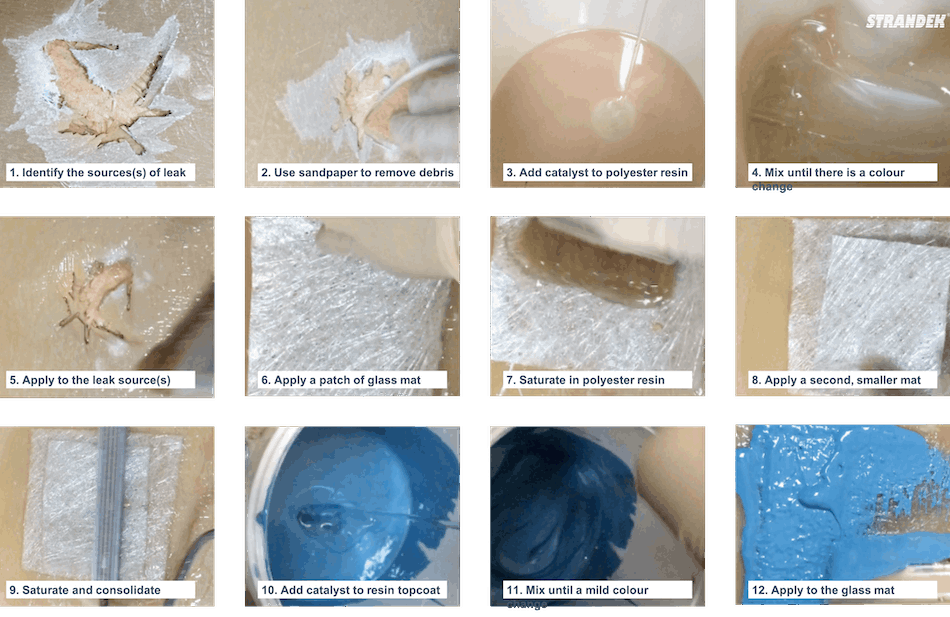
Glass fibre (also known as fibreglass or GRP) flat roofs can break down if they have been exposed to significant damage (e.g. heavy equipment placement). In such cases, a glass fibre repair kit can be used to make such repairs. This involves resin preparation, application and saturation of a glass fibre mat, prior to topcoat resin application. Be advised that the operator should closely follow the manufacturer’s instructions - these images are only meant as a loose guideline to support the repair process. 

Mobirise

WHEN A REPAIR PATCH ISN’T GOOD ENOUGH

Instances where the entire flat roof is breaking down (via age or poor materials/installation) often necessitate a new flat roof - or an overlay system, provided that the underlying support decking and insulation are undamaged.